
You’re researching the best train travel routes Europe has to offer. Smart move. You’ve probably already realized that “budget” airlines stopped being budget-friendly around the time they started charging €60 for a carry-on bag that’s 2cm too thick. And you lose half a day getting to some distant airport, stripping off your belt, and eating a €9 sad sandwich at the gate.
Trains don’t do that. They deposit you in the center of cities. You show up 10 minutes before departure. The seat pitch isn’t designed to destroy your knees. And you actually see the country you’re traveling through rather than a cloud layer and a patchwork of industrial farmland from 35,000 feet.
But not all European train routes are created equal. Some are overhyped tourist traps with dirty windows and broken AC. Others are genuinely better than flying—faster door-to-door, cheaper when booked right, and so scenic you’ll keep your phone out the entire time.
Here’s which routes are worth your money, which rail passes make sense, and the booking mistakes that cost you triple the price.
The Routes That Actually Beat Flying
Let’s define “beats flying.” I’m not talking about some romantic notion of slow travel where you spend 14 hours on a regional train because it’s “authentic.” I mean: door-to-door time is equal or shorter, the price is competitive, and you don’t want to scream at any point during the journey.
These three routes clear that bar.
| Route | Train Duration | Flight + Airport Time | Winner |
|---|---|---|---|
| Paris → Amsterdam (Eurostar) | 3h 20m | ~4h 30m (CDG to AMS + security + transit) | Train by 1+ hour |
| Madrid → Barcelona (Renfe AVE) | 2h 30m | ~4h (MAD to BCN + security + transit) | Train by 1.5 hours |
| Milan → Rome (Trenitalia Frecciarossa) | 2h 55m | ~4h 15m (MXP/LIN to FCO + security + transit) | Train by 1+ hour |
| London → Edinburgh (LNER) | 4h 20m | ~4h (LHR to EDI + security + transit) | Roughly equal. Train wins on comfort. |
The Paris to Amsterdam Eurostar is the clearest no-brainer. Gare du Nord to Amsterdam Centraal in 3 hours 20 minutes. Both stations are dead-center in their cities. Flying this route means getting to Charles de Gaulle an hour outside Paris, then Schiphol and a 20-minute train into Amsterdam. You save zero time and spend more money.
Madrid to Barcelona on the Renfe AVE is another route where flying makes almost no sense. The AVE trains run frequently, the seats are comfortable, and Atocha station is a 10-minute walk from the Prado. The alternative is a taxi to Barajas, security lines, a short flight, then a bus from El Prat into Barcelona. Pointless.
The Scenic Routes Worth Planning a Trip Around
Sometimes the journey is the destination. Cliche, but true for these two.
Bernina Express: Chur to Tirano
This is the single best alpine train route in Europe. Fight me on this. The Bernina Express runs from Chur, Switzerland to Tirano, Italy in about 4 hours. It climbs to 2,253 meters at the Ospizio Bernina station—the highest railway crossing in Europe—without using a rack-and-pinion system. The train just… climbs. Through 55 tunnels and over 196 bridges.
The Brusio spiral viaduct is the shot you’ve seen on Instagram. The train loops over itself to manage the gradient. It’s not a gimmick. It’s a genuine 1908 engineering solution that happens to look incredible.
What you need to know:
- Book the panoramic carriages. The windows curve up into the roof. Worth the €4-6 supplement.
- Reserve seats. The train fills up with tour groups by 10am.
- One-way tickets cost around €60-80. A Swiss Travel Pass covers most of the route.
- Go in late October. The larch trees turn gold. Summer is green and pretty but autumn is spectacular.
West Highland Line: Glasgow to Mallaig
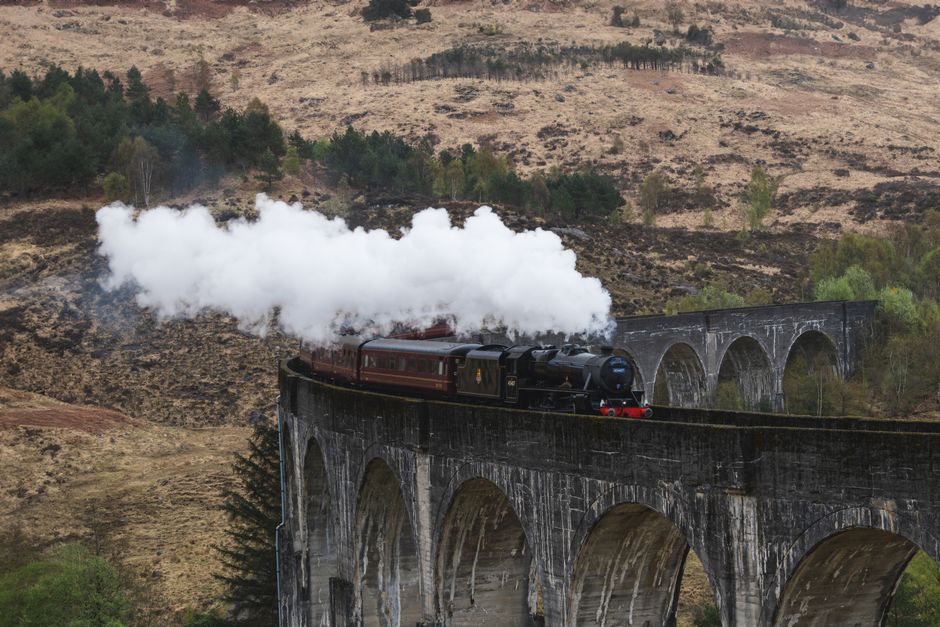
Scotland’s West Highland Line runs from Glasgow to the fishing port of Mallaig in about 5 hours. You cross Rannoch Moor, pass Ben Nevis, and finish at the coast. The Glenfinnan Viaduct—yes, the Harry Potter bridge—is on this route. The Jacobite steam train runs the same tracks in summer, but the regular ScotRail service uses the exact same route for a fraction of the price.
Book a window seat on the left side heading north. You’ll get the best views of Loch Lomond and the moorland. The regular ScotRail service costs around £30-40 booked in advance. The Jacobite tourist train charges £65+ for essentially the same views with more crowds and a steam locomotive.
The Rail Pass Question: When Eurail Makes Sense
Eurail passes are not automatically a good deal. The marketing makes it sound like unlimited freedom. The reality is you still need seat reservations on high-speed and night trains—and those reservations cost €10-25 each.
Here’s the math that matters.
A 7-day Eurail Global Pass costs around €350-400 for adults. If you’re taking 5-7 long-distance trains over two weeks, it probably pays off. If you’re taking three trains total, just buy point-to-point tickets.
Eurail works best when:
- You’re visiting 4+ countries in 2-3 weeks.
- You want flexibility—deciding the night before where to go next.
- You’re under 28. The youth pass is significantly cheaper.
Skip Eurail when:
- You’re doing 2-3 cities in one country. National rail operators sell advance tickets for €19-39.
- You’re in France or Italy mostly. Reservation fees are highest there (€10-25 per train).
- You know your exact dates. Advance point-to-point tickets will beat the pass price almost every time.
Book advance tickets through the national operators directly: SNCF Connect for France, Trenitalia for Italy, Renfe for Spain, DB Navigator for Germany. Avoid third-party booking sites like Rail Europe or Trainline when possible—they add booking fees for what you can do free on the operator’s own site. The one exception: if you need to book multiple countries in one transaction and don’t want to juggle five different apps, Trainline’s markup is sometimes worth the convenience.
Night Trains: The Comeback Story
Night trains died out around 2015-2016 as budget airlines undercut them. They’re coming back now, driven by climate-conscious travelers and the realization that a €39 flight that requires a €60 taxi to the airport at 4am isn’t actually cheaper.
The Nightjet network, run by Austrian Railways (ÖBB), is the best option right now. Key routes:
- Vienna → Venice: Departs around 9pm, arrives 8am. Couchette from €59. Wake up in Venice. This is objectively better than a 6am flight.
- Berlin → Zurich: Departs 8pm, arrives 9am. Private sleeper compartment from €89.
- Brussels → Vienna: Newer route. About 14 hours. Sleeper from €79.
The tradeoff is privacy vs. price. A seat in a six-berth couchette is cheap (€29-49). A private sleeper with a shower is €120-180. For two people, the private sleeper often costs less than a hotel night + a daytime train ticket combined. You’re paying for transport and accommodation in one.
Book Nightjet tickets directly at nightjet.com. They release tickets 6 months ahead. Summer weekend sleepers sell out within days.
The Booking Mistakes That Cost You Double
You can screw up European train bookings in predictable ways. Don’t do these.
Mistake 1: Booking too late. Unlike flights, European train tickets get more expensive as departure approaches. A Paris-Lyon TGV ticket might cost €25 booked 3 months out. Same ticket booked day-of: €100+. The cheapest fares (Prems in France, Super Economy in Italy) are non-refundable and non-changeable. Book early if your dates are fixed.
Mistake 2: Not checking the actual station. Some cities have multiple train stations. Paris has seven. The Eurostar leaves from Gare du Nord. TGVs to the south leave from Gare de Lyon. These are not the same place. A 30-minute Metro connection between stations is not built into your ticket. Miss the connection, and your reserved seat is gone.
Mistake 3: Assuming “first class” means something consistent. First class on a German ICE means slightly wider seats and a quieter carriage. First class on a Trenitalia Frecciarossa Executive class means a reclining armchair and complimentary prosecco. Same price tier, wildly different products. Check seat maps and reviews for the specific train type, not just the class label.
Mistake 4: Forgetting seat reservations on pass-holder tickets. Eurail pass covers the fare. It does not guarantee you a seat. In France, Italy, and Spain, high-speed trains require reservations. Show up without one and you’re standing in the vestibule for 3 hours—or getting fined. Reserve through the Eurail app or at station ticket offices a day ahead.
Your Phone Is Your Ticket, Until It Isn’t
Most European rail operators now accept mobile tickets. SNCF, Trenitalia, DB, and ÖBB all have functional apps with QR-code tickets. You don’t need to print anything.
But.
Your phone will die. Or the app will crash. Or you’ll lose signal at the exact moment the conductor appears. Have a backup. Screenshot the QR code. Save the PDF to your phone’s local storage. If you’re crossing borders, some conductors still want to see a printed reservation for night trains—especially on routes into Eastern Europe.
And for the love of everything, download the app and log in before you leave your hotel WiFi. The number of people fumbling with a registration email at the platform gate while the train doors close is not zero.
The best train travel routes Europe offers are not just a list of pretty views. They’re specific corridors where the infrastructure works, the booking system is straightforward, and the experience is genuinely better than the alternatives. The Paris-Amsterdam Eurostar, the Bernina Express, the Nightjet to Venice—these are routes where the train wins on merit, not nostalgia. Book early, reserve your seat, and keep a screenshot of your ticket. Then put your phone down and look out the window.